
How hospitals can use in-room tech to personalize care (and why they should)
 By Meghan Seus, SVP Product Management
Every patient in a hospital room brings a different story with them. Different conditions. Different fears. Different ideas of what “comfortable” even means.
And yet for decades, the room itself hasn’t known any of that. Same TV. Same channel guide. Same whiteboard with someone’s name hastily written in dry-erase marker, with questionable legibility.
That’s changing, and it’s one of the biggest shifts happening in healthcare design right now.
The technology already sitting in most patient rooms — the TV, the whiteboard, the door sign, the nurse call system — can flex around the person in the bed instead of the other way around.
Once you’ve seen what that shift can do for patients, families, and staff, it’s easy to get excited about getting your organization into where this is headed.
Why personalization is worth the investment
Personalized in-room technology isn’t just a hospitality nicety layered on top of clinical care; it’s genuinely connected to the outcomes hospitals already care about:
- Better clinical outcomes, driven by on-demand education tailored to a patient’s condition, real-time care plan visibility, and communication channels that keep patients and care teams aligned
- Stronger patient experience scores, because a room that recognizes who you are and what you need reduces the anxiety that comes with feeling like a bed number instead of a person
- Lighter staff workloads, since patients who can self-serve — adjusting lighting, requesting a blanket, reviewing their care plan — place fewer avoidable nurse calls
- More informed decisions, because personalized systems generate data on what patients actually use and need, not just what hospitals assume they use and need
I’ve sat in enough of these conversations to know the ROI question always comes back to something quite simple:
Does this change how patients feel and how staff work?
Done thoughtfully, the answer is yes to both.
What personalization actually looks like at the bedside
“Personalize care” can sound abstract until you see it in a room. Here’s where good design and technology are already making a real difference.
Displays that know who’s in the room
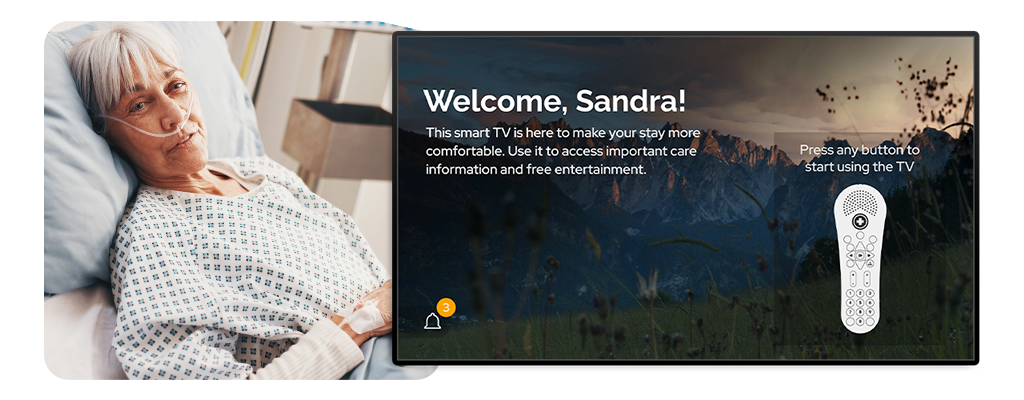
When in-room TVs and digital whiteboards are integrated with your EHR and ADT feeds, the screen isn’t generic, it’s built around that patient.
Names spelled correctly.
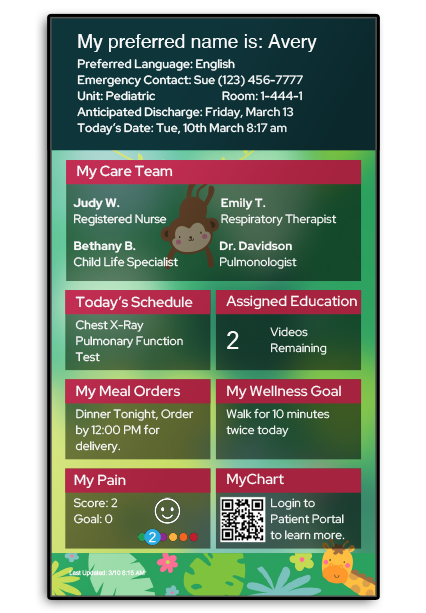
Care team members listed with photos and roles.
Allergies and fall-risk flags visible to staff at a glance.
It’s a small shift with an outsized effect on how welcome — and how safe — a patient feels.
Entertainment that feels like home
A patient recovering from surgery doesn’t want a curated hospital experience. They want their go-to comforts to pass the time and ease their mind.
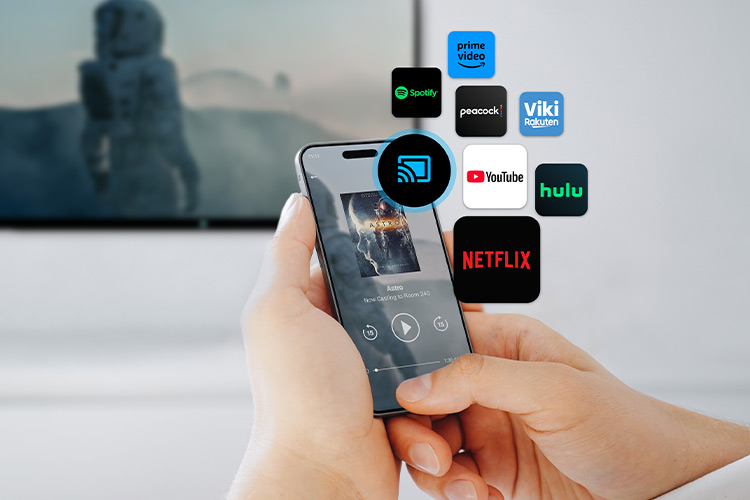
Streaming their personal accounts to the in-room TV, watching curated channel lineups and on-demand movies, and providing soothing and ambient options turns a sterile room into something closer to familiar.
That’s not a distraction from care.
For an anxious or isolated patient, that comfort is care.
Controls patients can adjust without a call button
Voice assistants, tablets, and mobile/BYOD controls let patients adjust their room’s TV, lighting, temperature, and shades themselves.
That’s autonomy for the patient and one less non-clinical interruption for a nurse already stretched thin.
Every smart room control a patient can safely manage on their own is a small win for both sides of the call button.
Education built around the diagnosis, not the department
Interactive systems that auto-assign education based on a patient’s specific condition — with prompts to watch it, and comprehension checks that chart straight back into the EHR — make education something patients actually absorb, with signals the care team can act on.
This sets up patients for success after their stay, especially in the days after discharge when the risk of readmission is highest.
Virtual care that meets patients where they already are
Patients and unit staff don’t need another device to learn.
They know how to use a TV.
Routing virtual nursing, remote consults, and specialist visits through the same in-room screen patients already trust removes friction for patients and clinicians alike.
It also extends virtually supported workflows into rooms that couldn’t easily access them before.
One size doesn’t fit all
Great personalization isn’t just about knowing who a patient is, it’s about understanding what stage of life or care they’re in, and designing around that.
A newborn’s family needs something completely different from a teenager going through chemo or a grandpa recovering from a fall.
A single template used identically across every unit is guaranteed not to meet the needs and expectations of all patients.
It needs to be flexible enough to be reconfigured room by room, population by population.
And it works when you have a partner who designs technology only after taking the time to understand what each type of patient and family actually wants and needs to feel cared for, and cared about.
Personalizing across patient populations
Pediatrics
A hospital stay can be one of the scariest experiences a kid (and their parents) will go through.
But personalizing in-room technology to the needs of pediatric patients and their families can make a huge difference.
They can stream favorites like Disney+, Netflix, and PBS, tune into playful distractions like a live zoo cam, and see relatable, kid-friendly details on their in-room whiteboard.
When a child is calm, procedures go faster and results are clearer, and parents get real relief knowing there’s an easy way to comfort their child beyond just waiting it out.
Oncology
Cancer treatment often means hours in a chair, appointment after appointment, and a level of anxiety most other patients don’t carry.
Curated, mood-lifting content and education tailored to specific diagnoses and treatment types help patients spend that time feeling reassured instead of just filling it.
Small things like a calming scene, a welcome distraction during infusion, or information about community-based support can make a genuinely hard day a little easier for patients and the families sitting beside them.
Med/surg
This is the most varied population in the hospital, so personalization here is as much about efficiency as comfort.
Condition-specific education assigned automatically through the EHR, care plan displays that update as shifts and orders change, integrated meal ordering and self-service room controls all add up to patients who feel informed and cared for, without adding extra work for a busy unit.
Postpartum
A birth is a celebration as much as a medical event, and the technology in the room should feel that way, too.
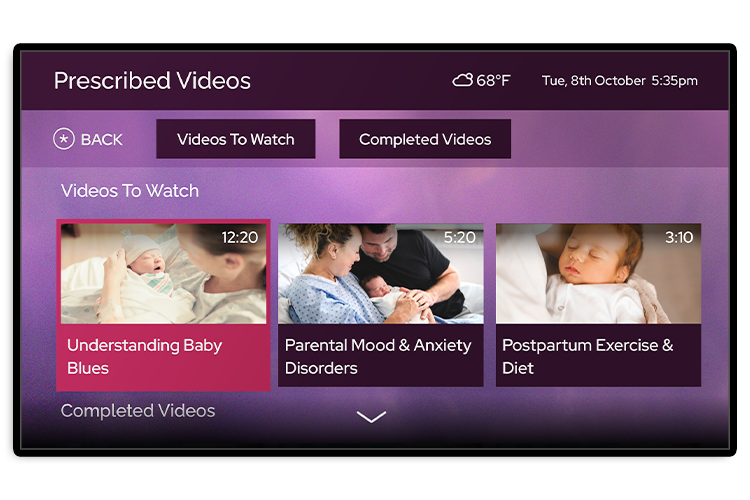
Family-inclusive displays, newborn care education for new parents, and content that balances the soothing ambience with must-know clinical details all help set the tone for one of the most significant days in a family’s life.
The case for starting now
None of this requires ripping out and replacing everything a hospital already has.
The best personalization strategies can be built on infrastructure that’s already in the room — whether that means focusing on the TV or layering thoughtful design onto a whiteboard or door sign if available— rather than adding one more device for staff to manage and patients to ignore.
Patient expectations have already shifted.
People walk in expecting the same kind of personalized, on-demand experience they get everywhere else in their lives, and a hospital room that doesn’t meet that expectation stands out…for the wrong reasons.
The hospitals getting this right aren’t chasing technology for its own sake.
They’re asking a simpler, more human question:
What would make this patient, in this room, feel seen?
Then they’re letting good technology grounded in human-based design answer it.