Virtual care resources

FAQs about acute virtual care & inpatient telehealth
There are a variety of use cases for virtual care in hospitals, such as admissions, discharge prep and coordination, nursing and physician rounding, nurse mentoring, procedure prep, specialist consults, pharmacy consults, education follow-up, medication reconciliation, safety checks, skin assessments, patient observation (i.e., e-sitting, tele-sitting) including AI support, interpreter and ASL services, family communication, and case management.
Yes, virtual care can help reduce the workload for bedside nurses, especially when the system is integrated with your EHR and clinical workflows. Hospitals often transfer tasks such as admissions and discharge prep to virtual nurses, saving bedside staff time and resources.
Some common tasks that virtual staff can successfully take over from bedside staff in a hospital setting include patient admissions, education follow-up, medication reconciliation, safety checks, patient observation, and discharge preparations.
Yes, virtual care systems can be set up to integrate with your existing clinical workflows. Make sure the vendors you partner with are experts in both the software and hardware requirements to make inpatient telehealth a seamless part of your patient care model.
Yes, virtual nursing can save costs, but it is dependent on how your organization includes virtual nursing in your clinical workflows.
Some organizations have seen great success with virtual nursing reducing their need for agency and travel nurses, eliminating the need for high-cost premium pay on certain shifts or units, keeping veteran nurses on staff in less physically demanding roles, and reducing turnover and vacancy costs.
Other long-term financial benefits virtual nursing could contribute to include lower readmission rates, reduced falls and adverse events, higher patient loyalty and HCAHPS, and better brand reputation.
The outcomes you see from virtual care will all depend on how and where you integrate telehealth as part of your care delivery model.
In general, the hospitals SONIFI Health has partnered with for integrated inpatient telehealth services have been tracking and seeing positive results for workforce outcomes (e.g., improved staff engagement scores, less turnover, fewer open vacancies, less agency use, fewer premium pay shifts, more efficient workflows, less documentation time); clinical care outcomes (e.g., faster throughput, reduced readmissions, reduced falls, reduced adverse events, shorter lengths of stay, faster discharges, more quality and safety catches, higher education completion and compliance); and patient satisfaction outcomes (e.g., improved HCAHPS scores, higher patient experience scores, more brand loyalty, more positive online reviews).
No. When integrated with a SONIFI Health interactive TV system, virtual care does not require any in-room intervention or presence from staff.
Our open API has been used by more than a dozen telehealth vendors to establish the interactive TV as a virtual care endpoint providers can “call” from within their EHR workflow.
An “auto answer” functionality will power on the TV if needed to automatically accept an incoming call. If a patient is watching TV or a movie, they will be notified of the incoming telehealth call and can accept or decline.
Upon completion of a call, patients are returned to the content they were viewing previously. This automatic return path reduces many nurse call button pushes from patients who would otherwise require assistance navigating back to their activity on the TV.
Virtual staff log updates in the patient’s EHR, triggering the next workflow in the process (e.g., follow-up rounding, education assignment, discharge preparations).
The equipment needed for telehealth will depend on your hospital’s goals and objectives. Identify the use cases and talk to vendors about options.
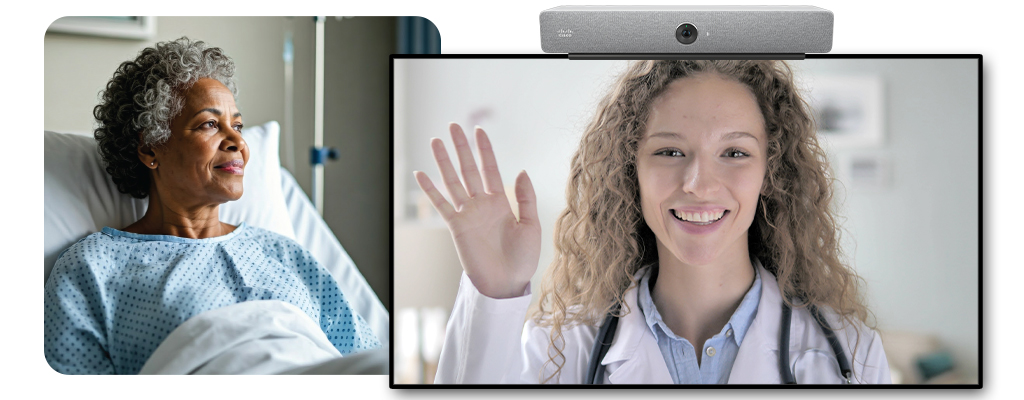
SONIFI Health recommends leveraging the TV that most patient rooms already have installed to create a telehealth system that integrates with your clinical workflows and is easy to use for both clinicians and patients.
Other hardware you’ll likely need are PTZ cameras and microphones.
Both tablets and TVs are viable solutions for virtual care in hospitals.
However, for the most long-term benefits, hospitals typically choose to integrate telehealth solutions with patient room TVs for a better experience.
Standalone tablets and mobile carts usually require nurses to track, charge, clean, schedule, locate, and configure separately for each patient, as opposed to an integrated interactive TV that can automatically connect the right clinician to the right patient in the right room.
A tablet-based solution relies on the patient or a nurse to reposition cameras for the virtual nurse or physician, whereas a TV-based solution typically has a dedicated camera that allows virtual clinicians to control what they see or zoom in on in the room.
SONIFI Health’s interactive TV system can integrate with the telehealth partner of your choice. We have successfully implemented integrated solutions with Vidyo, Amwell, Artisight, Care.ai, Caregility, CareView, Nesa/Epic, Hellocare, Teledoc, VitalChat, WebEx, CTi/VistaCom, and others upon request.
Because SONIFI Health partners with multiple telehealth solutions, your providers can continue using their established and familiar applications and workflows.
Our open API also makes it simple for health systems to change virtual care solutions over time, or use multiple vendors across the enterprise if desired.