 By SONIFI Health
 The repercussions of patients not understanding their healthcare needs can be costly and devastating.
When patients fail to complete their education, their health may rapidly decline because they didn’t understand the need for certain medications or how to take care of a health condition.
For your healthcare system, this will have a financial impact from preventable readmissions and multiple unnecessary visits to your emergency department.
Holistically, poor education completion rates are detrimental to patient safety and care quality, as well as your patient satisfaction and health equity initiatives.
Here are 8 barriers to patient learning, and what you can do to improve completion rates.
1. Literacy levels
The most basic barrier to education is that some patients cannot even read the education title you have given them.
About 21% of adults in the U.S. are illiterate1, and 54% of the population has below a 6th-grade literacy level.2 For patients with low literacy levels, written educational materials and discharge instructions will be nearly impossible to read, let alone comprehend and adhere to.
Some hospitals rely heavily on printed resources, but doing so may be reducing care plan effectiveness for a considerable portion of the patient population.
2. Health literacy
Health literacy differs from general literacy; patients may read and write well enough for everyday tasks, but still struggle to understand medical terminology or complex healthcare concepts.
If they’re not able to find, understand, and use information and services to successfully inform health-related decisions and actions3, their ability to manage care at home may be compromised.
3. Language
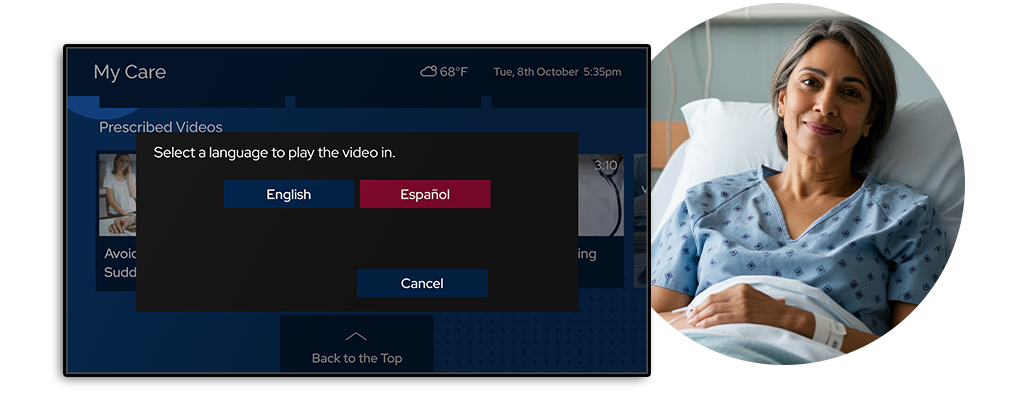
There’s no doubt of the ineffectiveness of health education and care instructions if they’re not in a patient’s preferred language.
Individuals with limited English proficiency may nod or verbally agree despite not fully understanding the information being shared.
4. Pain
Patients who are in significant pain, or who are using medication for pain or surgery, may have difficulty focusing and processing new information.
Education that’s not thoughtfully timed—such as delivery immediately after painful procedures and activities like physical therapy, dressing changes, and post-operative repositioning—will inevitably be ineffective.
5. Time constraints
Nurses are often the primary educators in the inpatient setting, but increasing patient acuity and heavy workloads can limit the time available for one-on-one teaching.
Clinical priorities will understandably take precedence, making consistent patient education challenging.
6. Inconsistent messaging
Patients may receive conflicting information from different members of their care team, which can create confusion and uncertainty once they return home.

7. Limited resources
Some healthcare organizations simply have limited tools available for patient education, often relying solely on printed discharge instructions.
This doesn’t support patients with different learning styles or literacy and language barriers.
When patients don’t have the support they need to complete education, it can cause delays in their healthcare decision-making and create an over-dependence on your staff or their caregivers for information.
8. Anxiety & information overload
If a patient is facing new or uncertain conditions, their fear and anxiety about their own health is likely heightened. In this state of distress, they’re unlikely to want to (or be able to) dive into education right away.
Too often, the majority of patient education is delivered on the day of discharge, when patients may already feel anxious about managing their care at home. Receiving too much information at once can be overwhelming.
When patients feel overwhelmed, they may become frustrated and annoyed, causing them to shut down and stop listening, eliminating any retention progress.
How you can help patients overcome learning barriers
Make it easy to understand
Use clear, plain language in all patient education. Include pictures and illustrations to help patients visualize key points.
Offer education in multiple languages, especially those most common in your community. For verbal teaching, use professional interpreters to avoid any miscommunication or misunderstandings.
To reach patients with varying literacy levels and learning styles, make your education accessible in multiple formats, such as:
- Demonstrations & teach-backs with clinical staff
- Printed materials
- Condition-specific videos
- Voice commands
- Online & patient portal resources
- Family caregiver materials
- Dedicated phone lines
Having education available in various forms also alleviates the need for nurses to cover everything for each patient.
Periodically, have your team audit your education to make sure content is standardized across verbal instructions, printed materials, videos, and digital resources to help ensure patients receive clear and consistent guidance.
Make it easy to access
Education is most effective when delivered in small, manageable pieces throughout the patient’s stay.
Offer education resources as early as possible so patients and their caregivers can review it when they are most receptive to it.
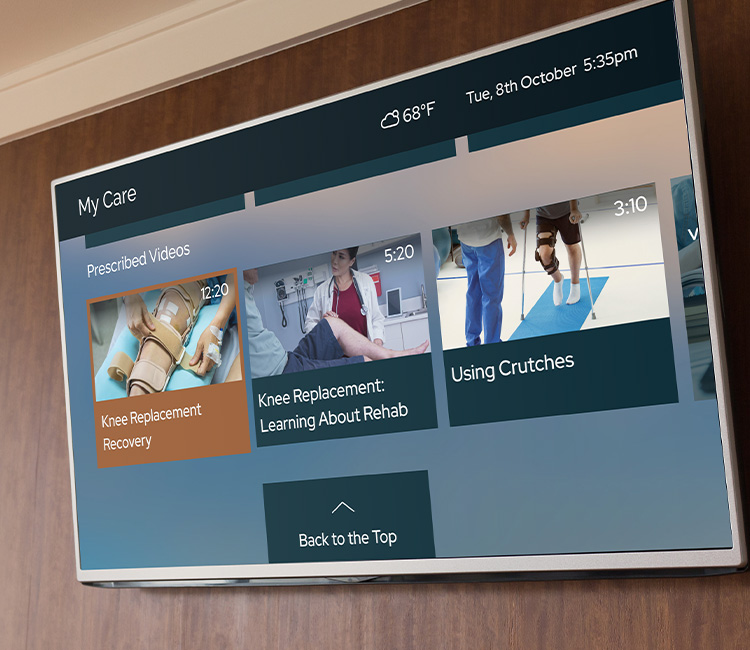
For example, on SONIFI Health’s interactive system, education videos are automatically assigned and available to watch on demand anytime.
Patients who are in pain or feeling anxious may need soft encouragement to complete their education. SONIFI’s interactive TV has automated prompts to review assigned videos.
The prompts don’t require patients to stop viewing entertainment or relaxation content, they simply provide a reminder that may reach them in a moment when they feel up to learning.
Patients using medication for pain or surgery may not be able to comprehend the education the first time, and may need it to be covered multiple times.
Having your education videos and other materials available and repeatable anytime lets patients take in the information at their own pace, as many times as needed.
This gives patients and their families ample time to ask for clarifications or follow-up before discharge, preparing them for a successful return home.
Ask for best practices
At SONIFI Health, we constantly collaborate with healthcare systems on how to improve education.
We can help you assess what would be most valuable and useful for your patients and your staff, and offer solutions that help patients successfully overcome their learning barriers.

Stay connected
Get exclusive insights delivered to your inbox from our experts.